
AI Consulting Services in Singapore: A Practical Guide for Business Leaders
AI consulting services in Singapore help companies identify, plan, implement, and govern artificial intelligence solutions that improve productivity, reduce manual work, support better decision-making, and create measurable business outcomes. A strong AI consultant does not simply recommend tools. They help your business redesign workflows, train employees, protect data, measure ROI, and adopt AI responsibly.
Artificial Intelligence is no longer a futuristic boardroom topic. It has become a practical business capability.
For Singapore businesses, AI adoption is moving quickly from curiosity to execution. Employees are already using tools such as ChatGPT, Microsoft Copilot, Gemini, Claude, Perplexity, Canva AI, Notion AI, and many other AI-powered applications. Sales teams are using AI to draft proposals. Marketing teams are using AI to create campaigns. HR teams are using AI to screen candidates. Finance teams are using AI to summarise reports. Customer service teams are using AI to respond faster.
The challenge is not whether AI is entering your business.
It already is.
The real question is whether AI adoption is happening strategically, securely, and profitably, or whether your company is drifting into unmanaged “shadow AI”, where staff use random tools without clear rules, data protection, workflow redesign, or management oversight.
This is where AI consulting services in Singapore become highly valuable.
A good AI consulting partner helps business owners, CEOs, directors, and department heads move from scattered experimentation to structured implementation. The goal is not to make your company look modern. The goal is to create measurable business value.
That value may come from faster work, better customer response, stronger sales execution, reduced operational waste, improved reporting, better knowledge management, safer AI usage, or a more future-ready workforce.
Why AI Consulting Matters in Singapore Now
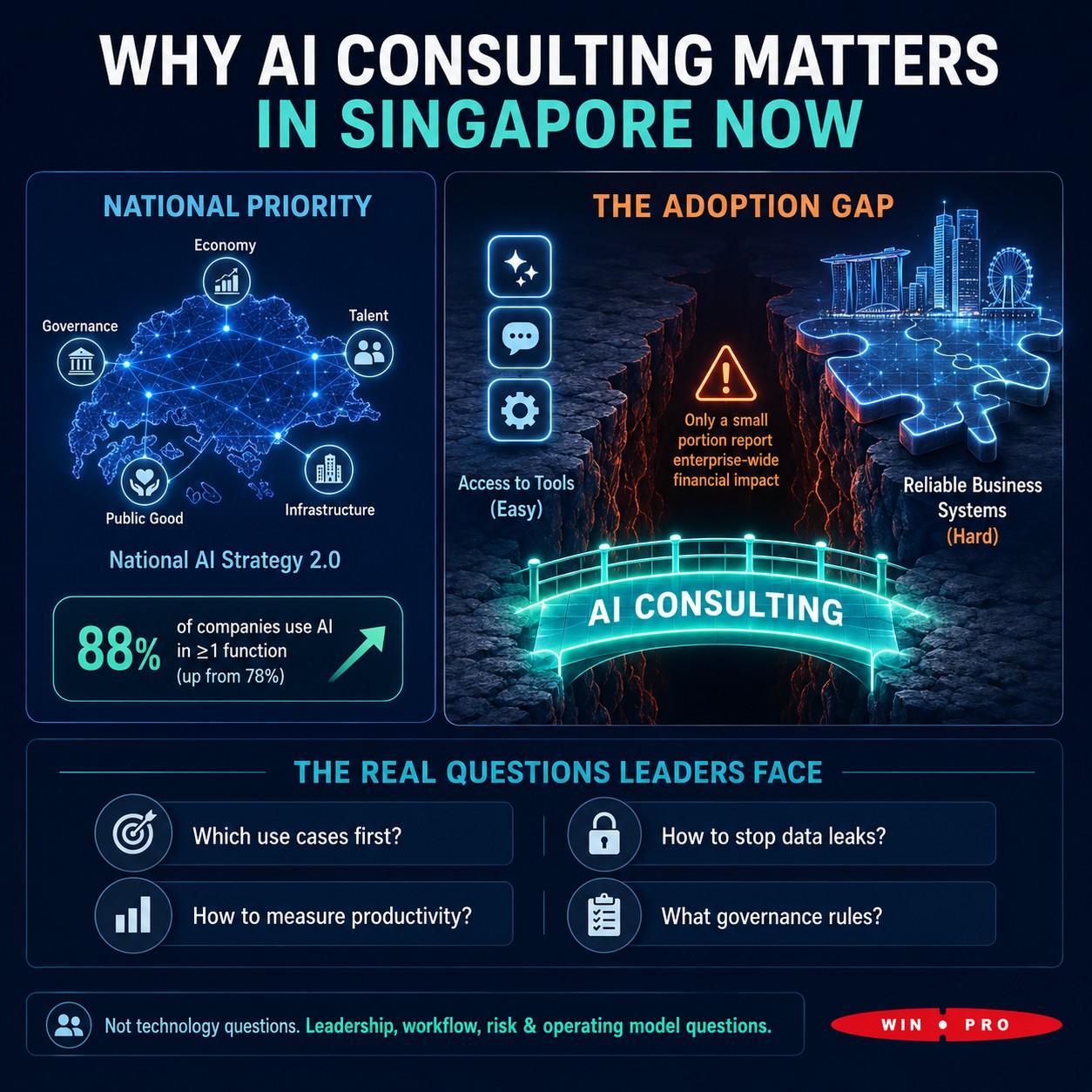
Singapore has made AI a national priority. The country’s National AI Strategy 2.0 has positioned AI as an important driver of economic growth, public good, talent development, trusted AI environments, and business transformation. Singapore is also frequently used as a benchmark in AI policy and national AI strategy research because of its coordinated approach to AI governance, talent, infrastructure, and industry adoption.
At the same time, global business adoption of AI is accelerating. McKinsey’s 2025 State of AI reporting, as cited in recent business coverage, found that 88% of companies reported using AI in at least one business function, up from 78% the year before. However, only a smaller portion reported meaningful enterprise-wide financial impact, which shows the gap between using AI tools and actually transforming business performance.
This matters for Singapore SMEs and enterprises because AI adoption is no longer just about access to technology. Most companies can already access AI tools. The harder problem is turning those tools into reliable business systems.
Many companies face the same questions:
- Which AI use cases should we prioritise first?
- How do we stop staff from uploading confidential data into public AI tools?
- How do we measure productivity gains?
- How do we train non-technical employees?
- Should we use Microsoft Copilot, ChatGPT Enterprise, custom AI agents, workflow automation tools, or industry-specific platforms?
- How do we prevent AI-generated mistakes from reaching customers?
- What governance rules should be in place?
- How do we move beyond random experimentation?
These are not just technology questions. They are leadership, workflow, risk, and operating model questions.
That is why AI consulting has become important. It helps companies adopt AI with structure instead of guesswork.
What Are AI Consulting Services?
AI consulting services are professional advisory and implementation services that help organisations use artificial intelligence to solve business problems. These services may include AI strategy, AI readiness assessment, workflow automation, generative AI implementation, AI governance, staff training, data preparation, tool selection, and change management.
In simple terms, an AI consultant helps your company answer three practical questions:
- Where can AI create real business value?
- How should we implement AI safely and effectively?
- How do we get employees to use AI properly in daily work?
This is different from simply selling software.
A software vendor may sell you an AI tool. An AI consultant helps you decide whether that tool fits your business, how it should be deployed, how staff should use it, what risks must be managed, and how success should be measured.

What Does an AI Consultant Do?
An AI consultant in Singapore typically helps businesses with seven major areas.
AI Readiness Assessment
An AI readiness assessment evaluates whether your business is prepared to adopt AI successfully.
It usually reviews:
- Business goals
- Current workflows
- Repetitive manual tasks
- Data quality
- Existing software systems
- Cybersecurity risks
- Staff capability
- Management support
- Compliance needs
- AI policy gaps
- Automation opportunities
The purpose is to avoid the common mistake of buying AI tools before understanding the business problem.
A good readiness assessment should produce a clear answer:
“These are the best AI opportunities for your business, these are the risks, and this is the recommended implementation sequence.”
This is especially important for SMEs because resources are limited. You do not want to spend money on an impressive AI system that nobody uses.

AI Strategy Development
AI strategy connects AI adoption to business outcomes.
A practical AI strategy should define:
- Priority use cases
- Expected business value
- Departments involved
- Required tools
- Data requirements
- Training needs
- Risk controls
- Governance rules
- Budget range
- Implementation timeline
- Success metrics
For example, a Singapore SME may not need a custom machine learning model. It may get faster results from AI-powered sales follow-up, document automation, customer service support, proposal generation, or internal knowledge search.
An enterprise may need a more advanced strategy involving secure AI environments, enterprise data architecture, retrieval-augmented generation, AI governance, risk management, and business-wide adoption.
The right strategy depends on business maturity, budget, staff readiness, data quality, and risk appetite.
AI Use Case Prioritisation
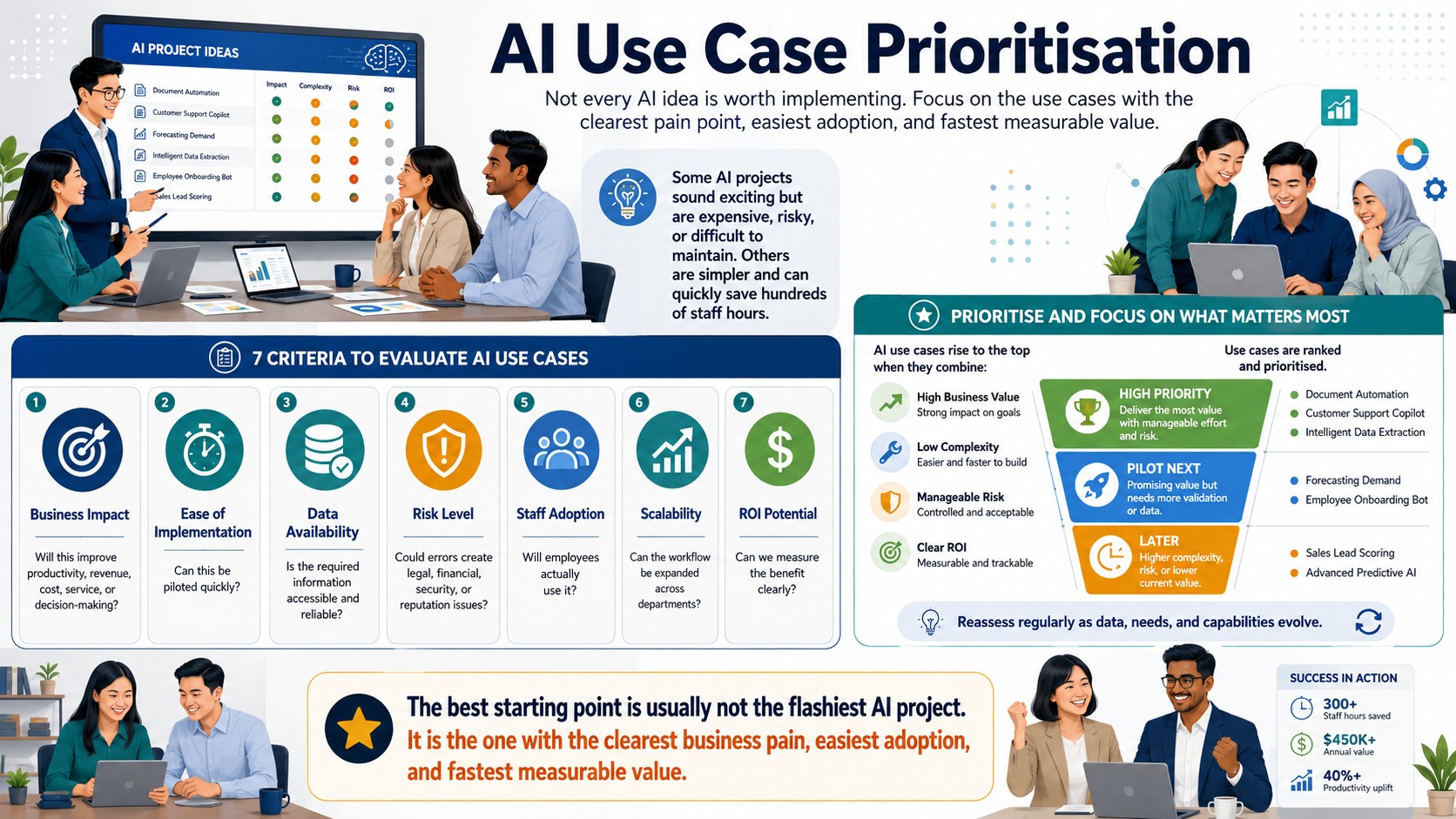
Not every AI idea is worth implementing.
Some use cases sound exciting but are expensive, risky, or difficult to maintain. Others are simple but can quickly save hundreds of staff hours.
A good AI consultant helps prioritise use cases based on:
| Criteria | Why It Matters |
|---|---|
| Business impact | Will this improve productivity, revenue, cost, service, or decision-making? |
| Ease of implementation | Can this be piloted quickly? |
| Data availability | Is the required information accessible and reliable? |
| Risk level | Could errors create legal, financial, security, or reputation issues? |
| Staff adoption | Will employees actually use it? |
| Scalability | Can the workflow be expanded across departments? |
| ROI potential | Can we measure the benefit clearly? |
For most companies, the best starting point is not the flashiest AI project. It is the project with the clearest business pain, easiest adoption, and fastest measurable value.
AI Workflow Automation
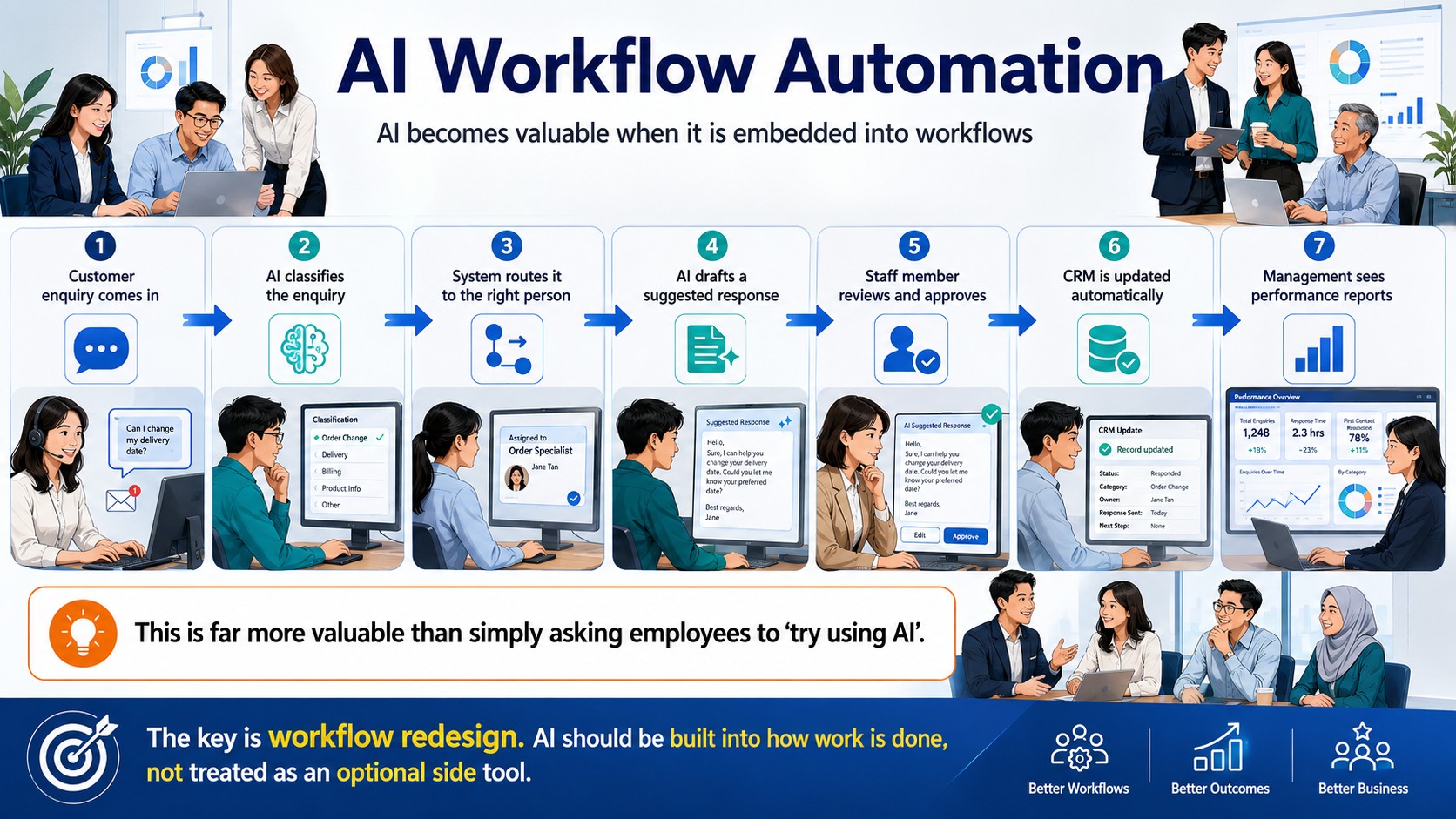
AI becomes valuable when it is embedded into workflows.
For example:
- Customer enquiry comes in.
- AI classifies the enquiry.
- The system routes it to the right person.
- AI drafts a suggested response.
- A staff member reviews and approves.
- The CRM is updated automatically.
- Management sees performance reports.
This is far more valuable than simply asking employees to “try using AI”.
AI workflow automation may improve:
- Sales follow-up
- Lead qualification
- Customer service
- HR screening
- Employee onboarding
- Invoice processing
- Report generation
- IT support ticket triage
- Marketing content production
- Compliance documentation
- Knowledge management
The key is workflow redesign. AI should be built into how work is done, not treated as an optional side tool.
Generative AI Implementation
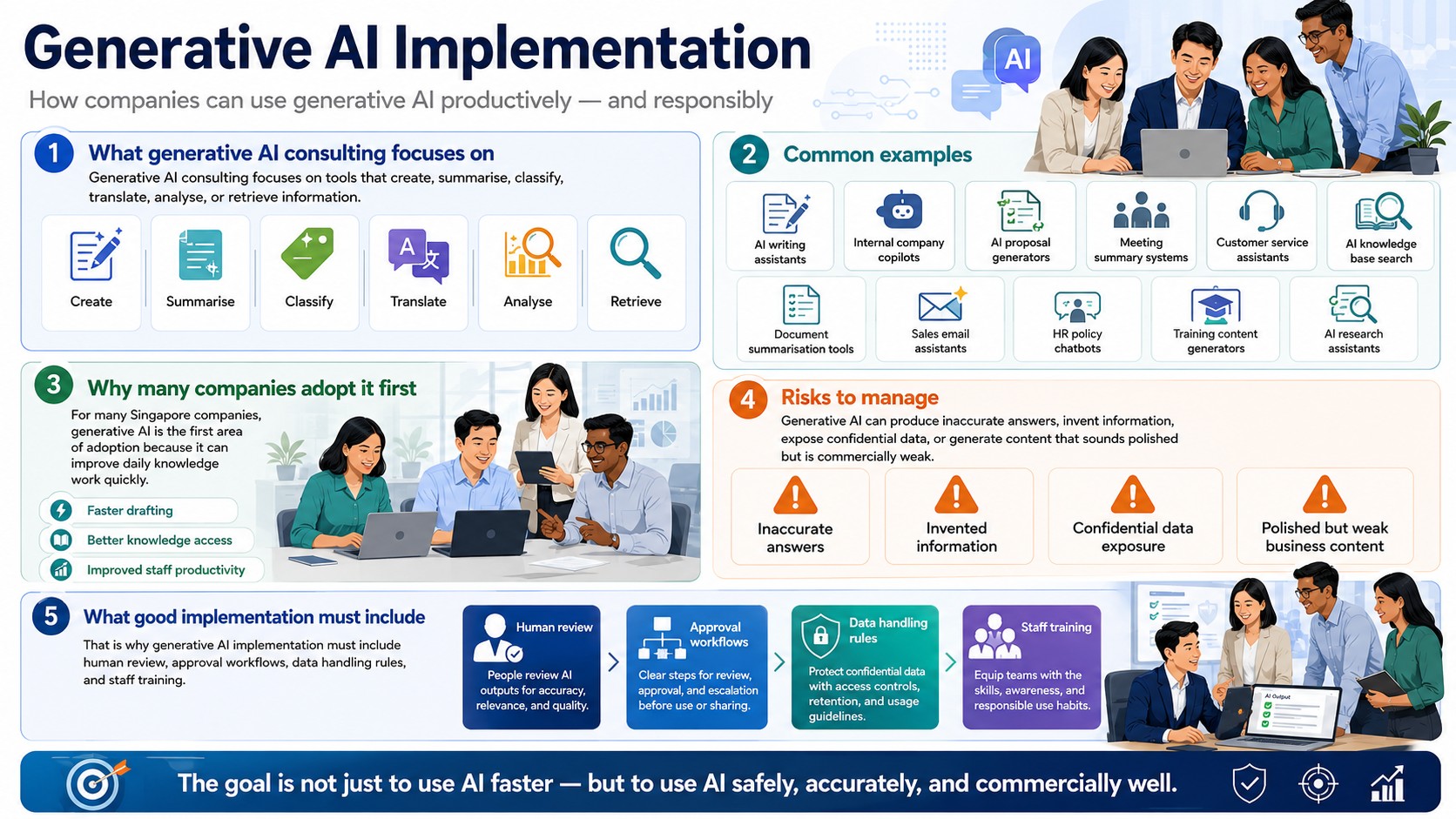
Generative AI consulting focuses on tools that create, summarise, classify, translate, analyse, or retrieve information.
Common examples include:
- AI writing assistants
- Internal company copilots
- AI proposal generators
- Meeting summary systems
- Customer service assistants
- AI knowledge base search
- Document summarisation tools
- Sales email assistants
- HR policy chatbots
- Training content generators
- AI research assistants
For many Singapore companies, generative AI is the first area of adoption because it can improve daily knowledge work quickly.
However, generative AI also introduces risks. AI can produce inaccurate answers, invent information, expose confidential data, or generate content that sounds polished but is commercially weak.
That is why generative AI implementation must include human review, approval workflows, data handling rules, and staff training.
AI Governance and Risk Management
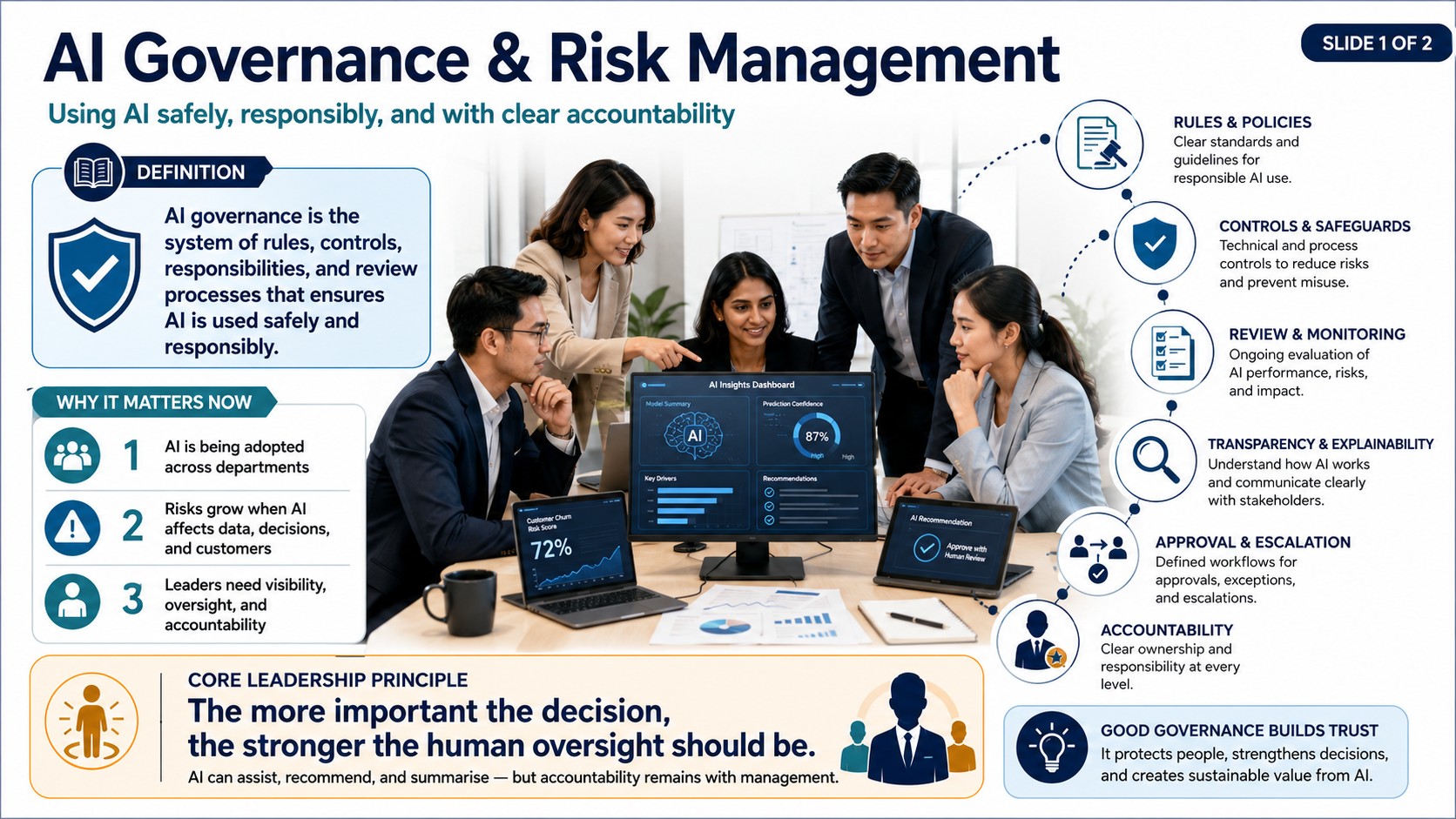
AI governance is the system of rules, controls, responsibilities, and review processes that ensures AI is used safely and responsibly.
This is becoming more important as companies adopt AI across departments.
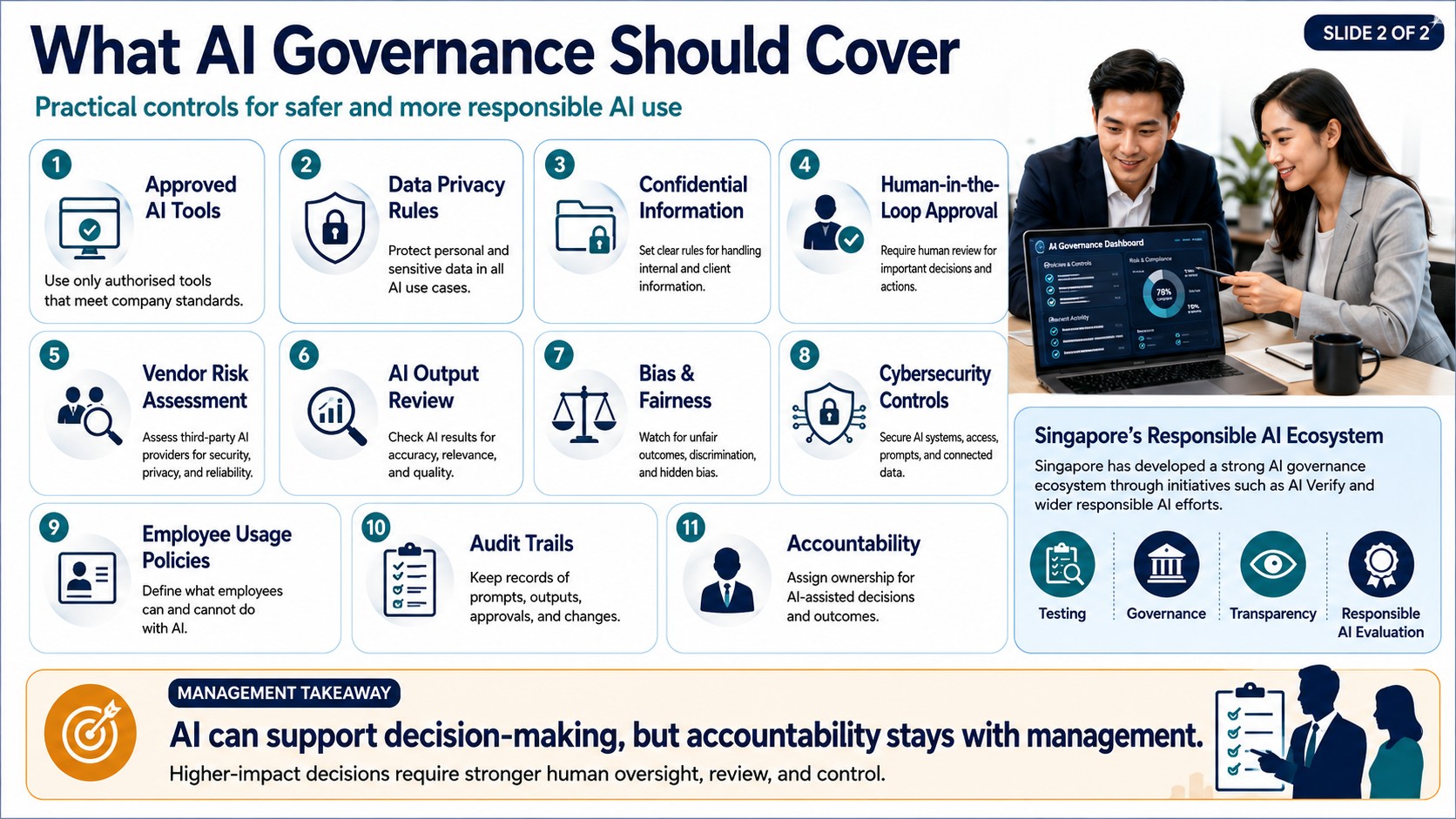
AI governance should cover:
- Approved AI tools
- Data privacy rules
- Confidential information handling
- Human-in-the-loop approval
- Vendor risk assessment
- AI output review
- Bias and fairness considerations
- Cybersecurity controls
- Employee usage policies
- Audit trails
- Accountability for AI-assisted decisions
Singapore has also developed a strong AI governance ecosystem through initiatives such as AI Verify and wider responsible AI efforts. AI Verify is connected to testing, governance, transparency, and responsible AI evaluation, which are increasingly relevant as businesses adopt AI in real operations.
For business leaders, the principle is simple:
The more important the decision, the stronger the human oversight should be.
AI can assist. AI can recommend. AI can summarise. But accountability remains with management.
AI Training and Change Management
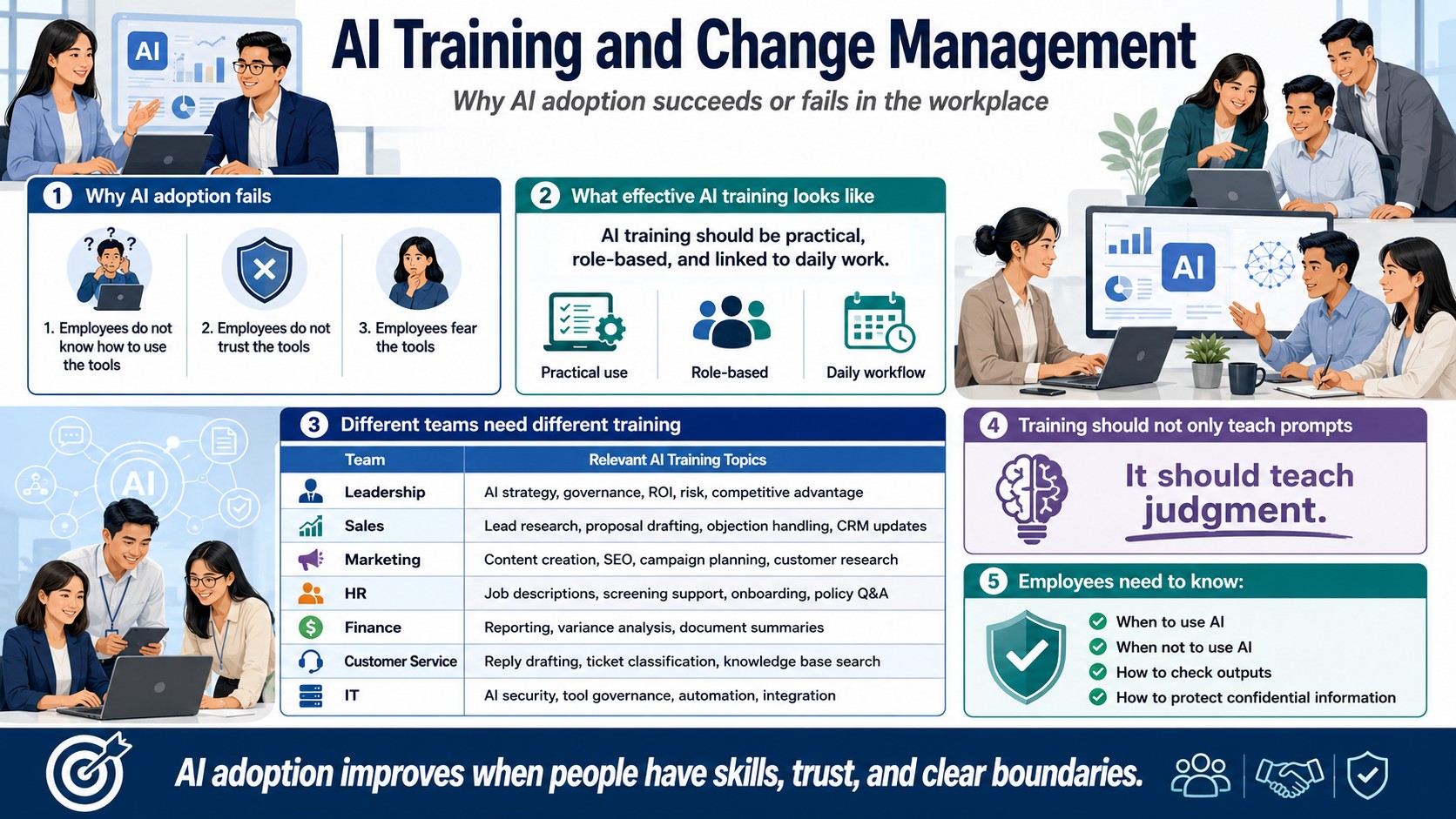
AI adoption fails when employees do not know how to use the tools, do not trust the tools, or fear the tools.
AI training should be practical, role-based, and linked to daily work.
Different teams need different training:
Training should not only teach prompts. It should teach judgment.
Employees need to know when to use AI, when not to use AI, how to check outputs, and how to protect confidential information.
Benefits of AI Consulting Services in Singapore
Improved Productivity
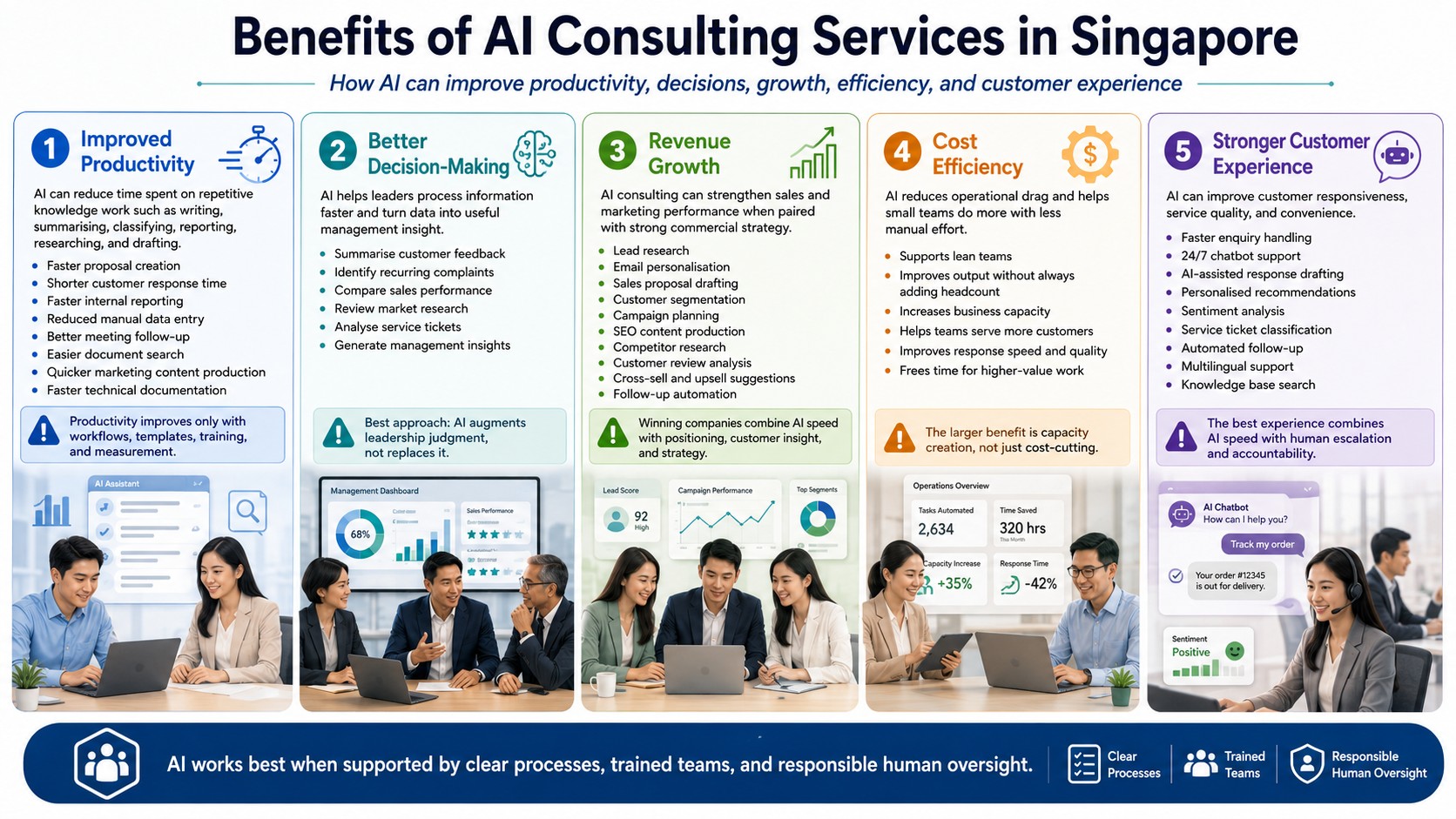
AI can reduce the time spent on repetitive knowledge work such as writing, summarising, classifying, reporting, researching, and drafting.
Typical productivity gains may come from:
- Faster proposal creation
- Shorter customer response time
- Faster internal reporting
- Reduced manual data entry
- Better meeting follow-up
- Easier document search
- Quicker marketing content production
- Faster technical documentation
However, productivity does not improve automatically. Companies need standard workflows, templates, training, and measurement.
Without structure, some employees become more productive while others use AI poorly or not at all.
Better Decision-Making
AI can help leaders process information faster.
For example, AI can summarise customer feedback, identify recurring complaints, compare sales performance, review market research, analyse service tickets, and generate management insights.
This supports better decision-making, but AI should not replace leadership judgment.
The best approach is AI augmentation, where AI supports human thinking rather than replacing it.
Revenue Growth
AI consulting can also support sales and marketing performance.
AI can help with:
- Lead research
- Email personalisation
- Sales proposal drafting
- Customer segmentation
- Campaign planning
- SEO content production
- Competitor research
- Customer review analysis
- Cross-sell and upsell suggestions
- Follow-up automation
The danger is generic output. Many companies are now using AI to produce the same bland content. The companies that win will combine AI speed with strong positioning, customer insight, and clear commercial strategy.
Cost Efficiency
AI can reduce operational drag by helping staff complete more work with less manual effort.
For SMEs, this may be especially valuable because small teams often handle multiple responsibilities.
AI can act as a productivity layer across the business, helping teams produce better work without always increasing headcount.
However, business leaders should be careful not to view AI only as a cost-cutting tool. In many cases, the larger benefit is capacity creation: the same team can serve more customers, respond faster, improve quality, and spend more time on higher-value work.
Stronger Customer Experience
Customers expect fast, accurate, and helpful responses.
AI can improve customer experience through:
- Faster enquiry handling
- 24/7 chatbot support
- AI-assisted response drafting
- Personalised recommendations
- Sentiment analysis
- Service ticket classification
- Automated follow-up
- Multilingual support
- Knowledge base search
But customer-facing AI must be handled carefully. Poorly designed chatbots can damage trust. AI should reduce friction, not remove accountability.
The best customer experience combines AI speed with human escalation.
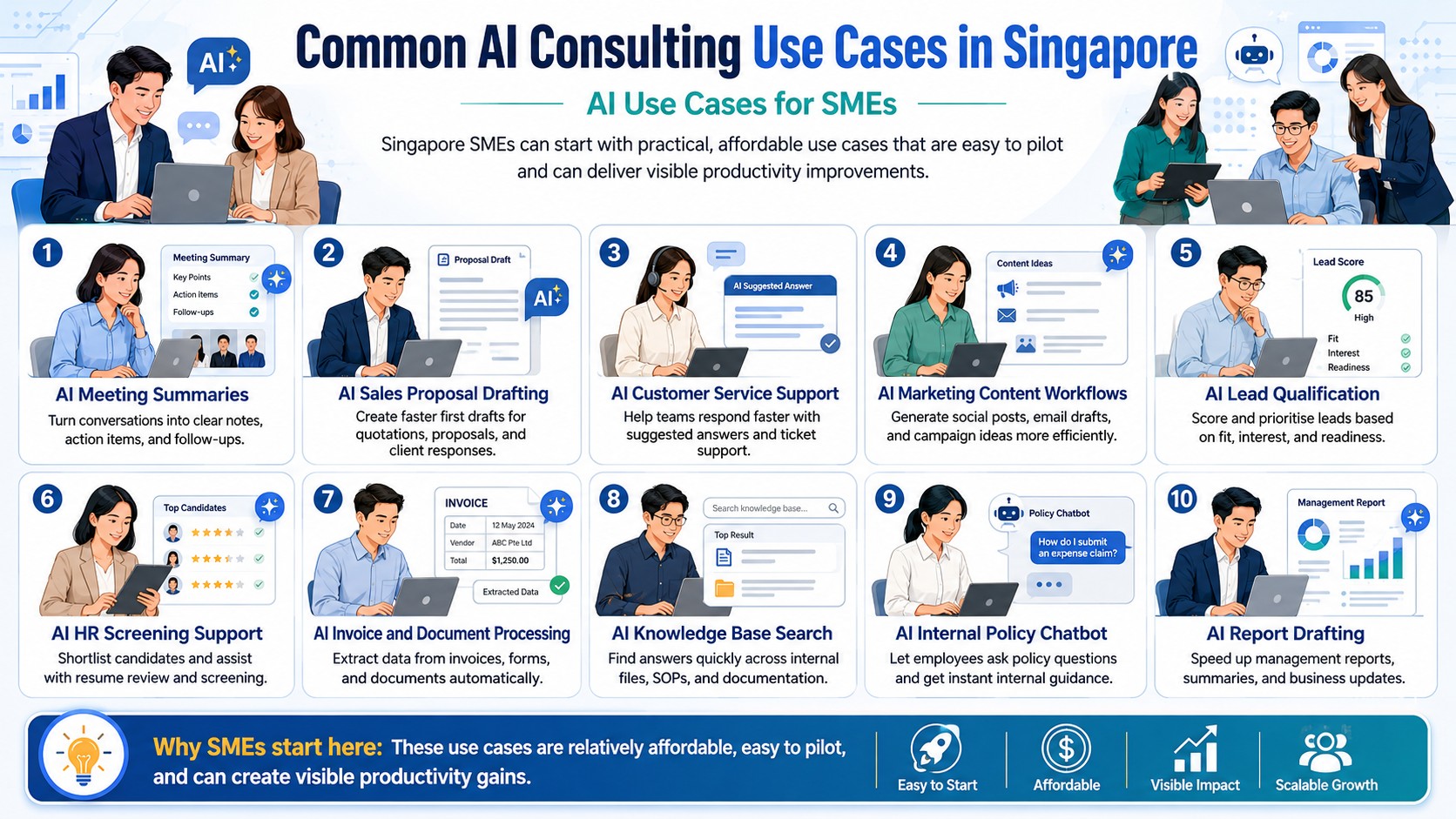
Common AI Consulting Use Cases in Singapore
AI Use Cases for SMEs
Singapore SMEs can start with practical, affordable use cases such as:
- AI meeting summaries
- AI sales proposal drafting
- AI customer service support
- AI marketing content workflows
- AI lead qualification
- AI HR screening support
- AI invoice and document processing
- AI knowledge base search
- AI internal policy chatbot
- AI report drafting
These use cases are attractive because they are relatively easy to pilot and can create visible productivity improvements.
AI Use Cases for Enterprises
Larger companies may require more advanced AI consulting services such as:
- Enterprise AI strategy
- AI governance framework
- Secure internal AI copilots
- Retrieval-augmented generation systems
- AI risk assessment
- Data architecture review
- AI vendor evaluation
- Department-level AI roadmaps
- AI operating model design
- AI adoption measurement
- AI security and compliance controls
For enterprises, the challenge is often coordination. Different departments may adopt different AI tools without a shared strategy. This creates duplication, inconsistent data handling, and governance risk.
An AI consultant helps bring structure to enterprise-wide AI adoption.
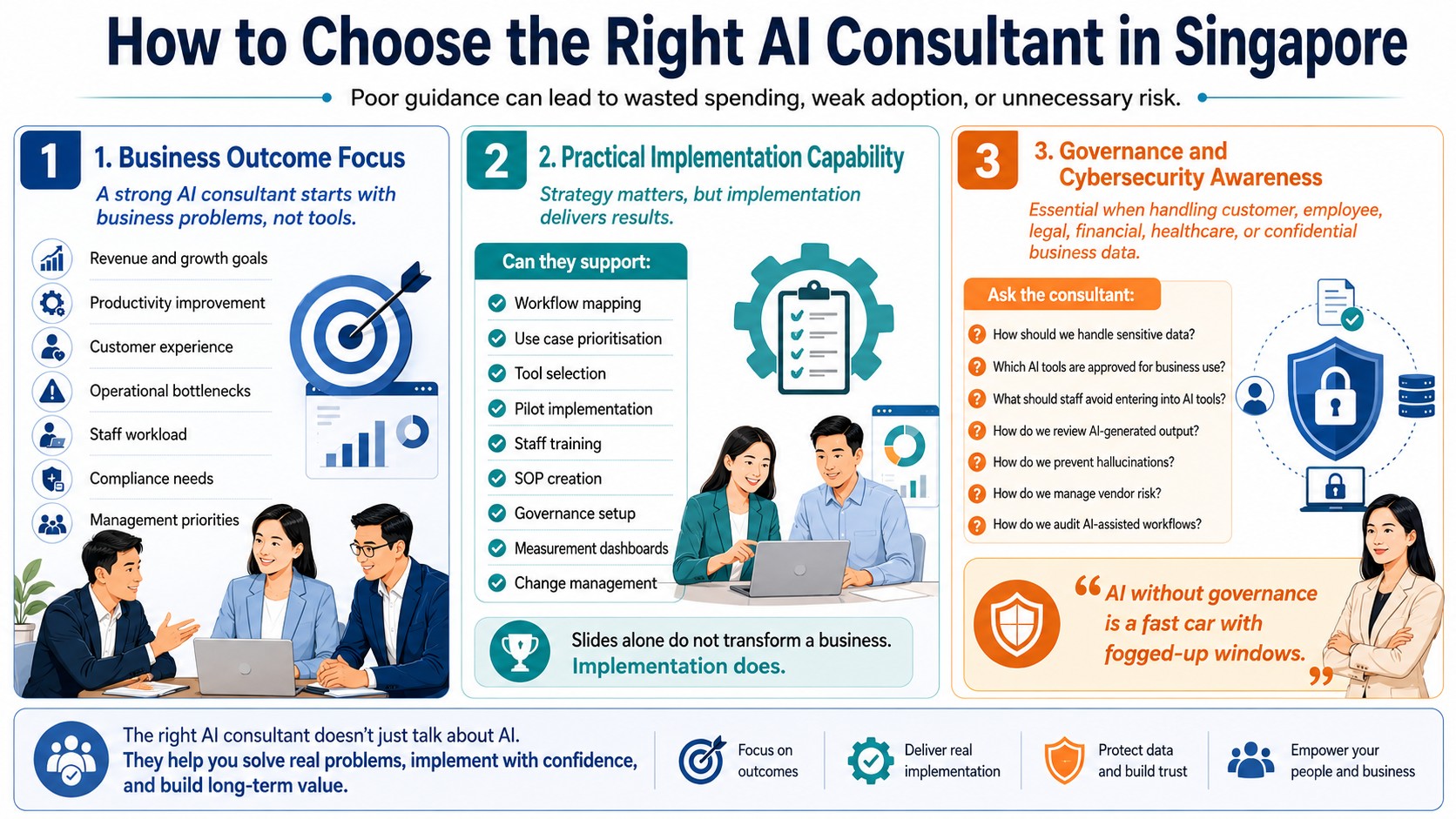
How to Choose the Right AI Consultant in Singapore
Choosing the right AI consultant is important because poor guidance can lead to wasted spending, weak adoption, or unnecessary risk.
Here are the key factors to consider.
1) Business Outcome Focus
The consultant should start with business problems, not tools.
They should ask about revenue, productivity, customer experience, operational bottlenecks, staff workload, compliance, and management goals.
2) Practical Implementation Capability
A good AI consultant should be able to help with implementation, not only strategy.
Ask whether they can support:
- Workflow mapping
- Use case prioritisation
- Tool selection
- Pilot implementation
- Staff training
- SOP creation
- Governance setup
- Measurement dashboards
- Change management
Slides alone do not transform a business. Implementation does.
3) Governance and Cybersecurity Awareness
This is essential for businesses handling customer data, financial records, employee data, legal documents, healthcare information, or confidential business information.
Ask the consultant:
- How should we handle sensitive data?
- Which AI tools are approved for business use?
- What should staff avoid entering into AI tools?
- How do we review AI-generated output?
- How do we prevent hallucinations?
- How do we manage vendor risk?
- How do we audit AI-assisted workflows?
AI without governance is a fast car with fogged-up windows.
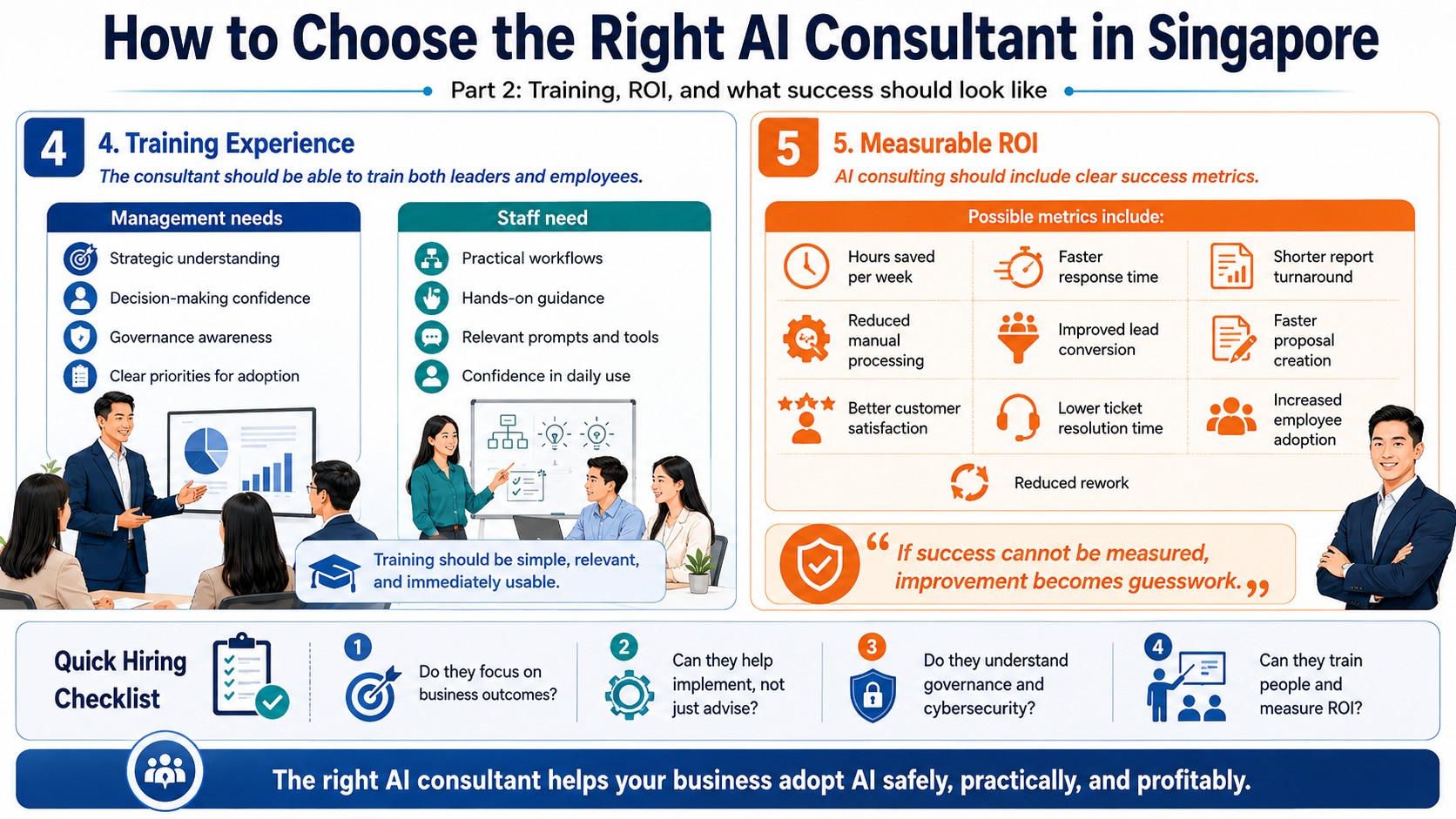
4) Training Experience
The consultant should be able to train both leaders and employees.
Management needs strategic understanding. Staff need practical workflows.
Training should be simple, relevant, and immediately usable.
5) Measurable ROI
AI consulting should include success metrics.
Possible metrics include:
- Hours saved per week
- Faster response time
- Shorter report turnaround
- Reduced manual processing
- Improved lead conversion
- Faster proposal creation
- Better customer satisfaction
- Lower ticket resolution time
- Increased employee adoption
- Reduced rework
If success cannot be measured, improvement becomes guesswork.
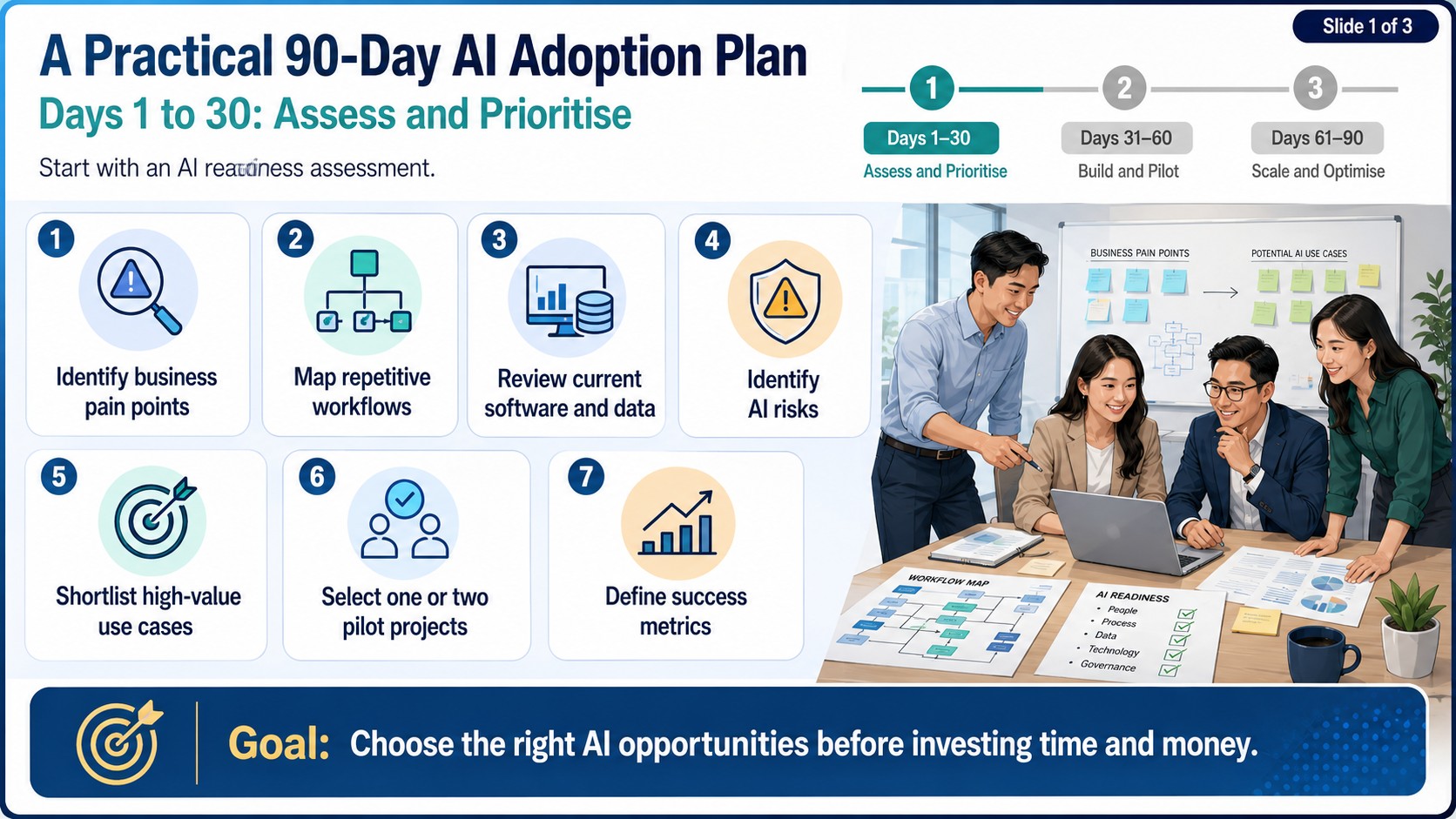
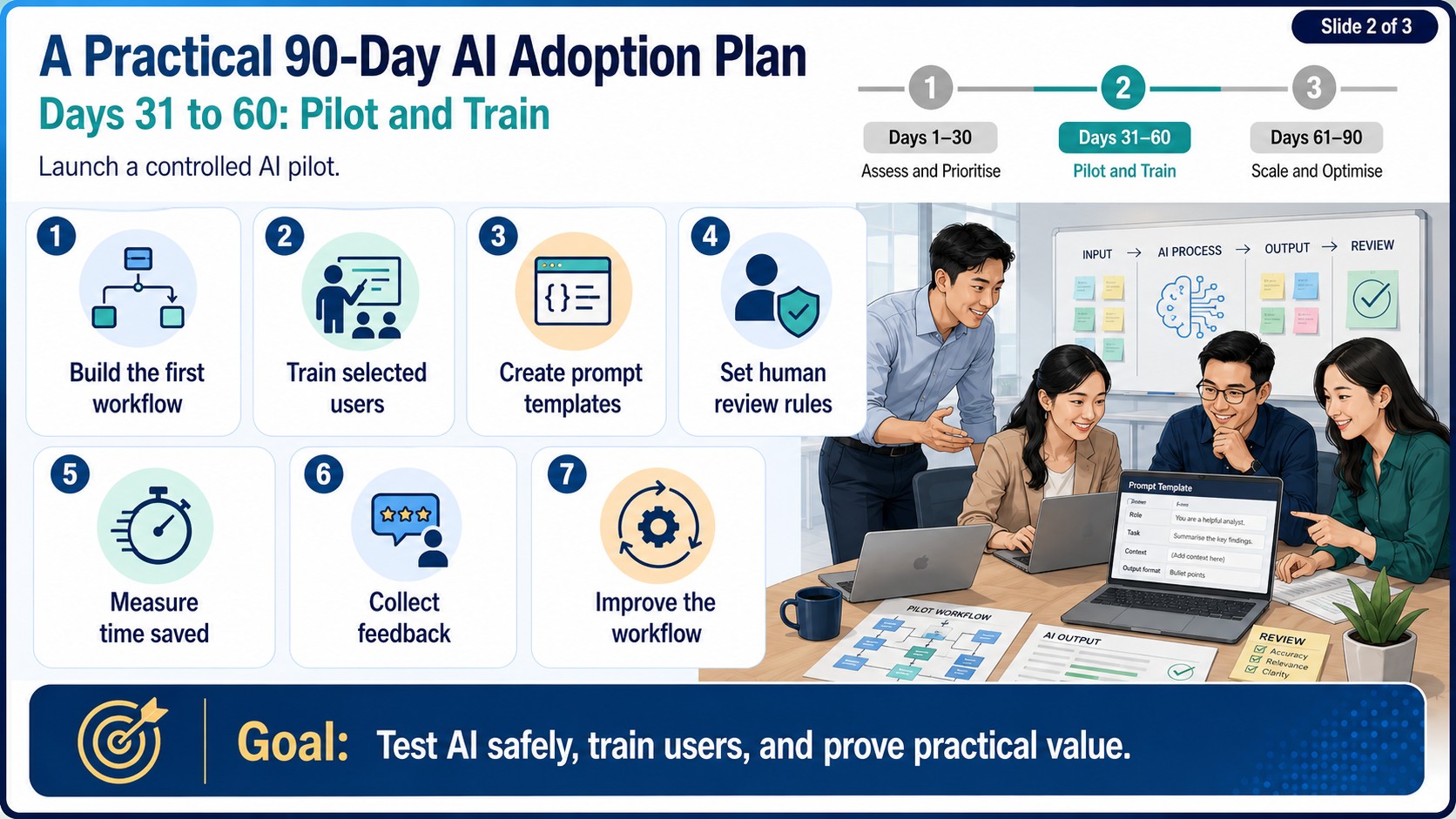
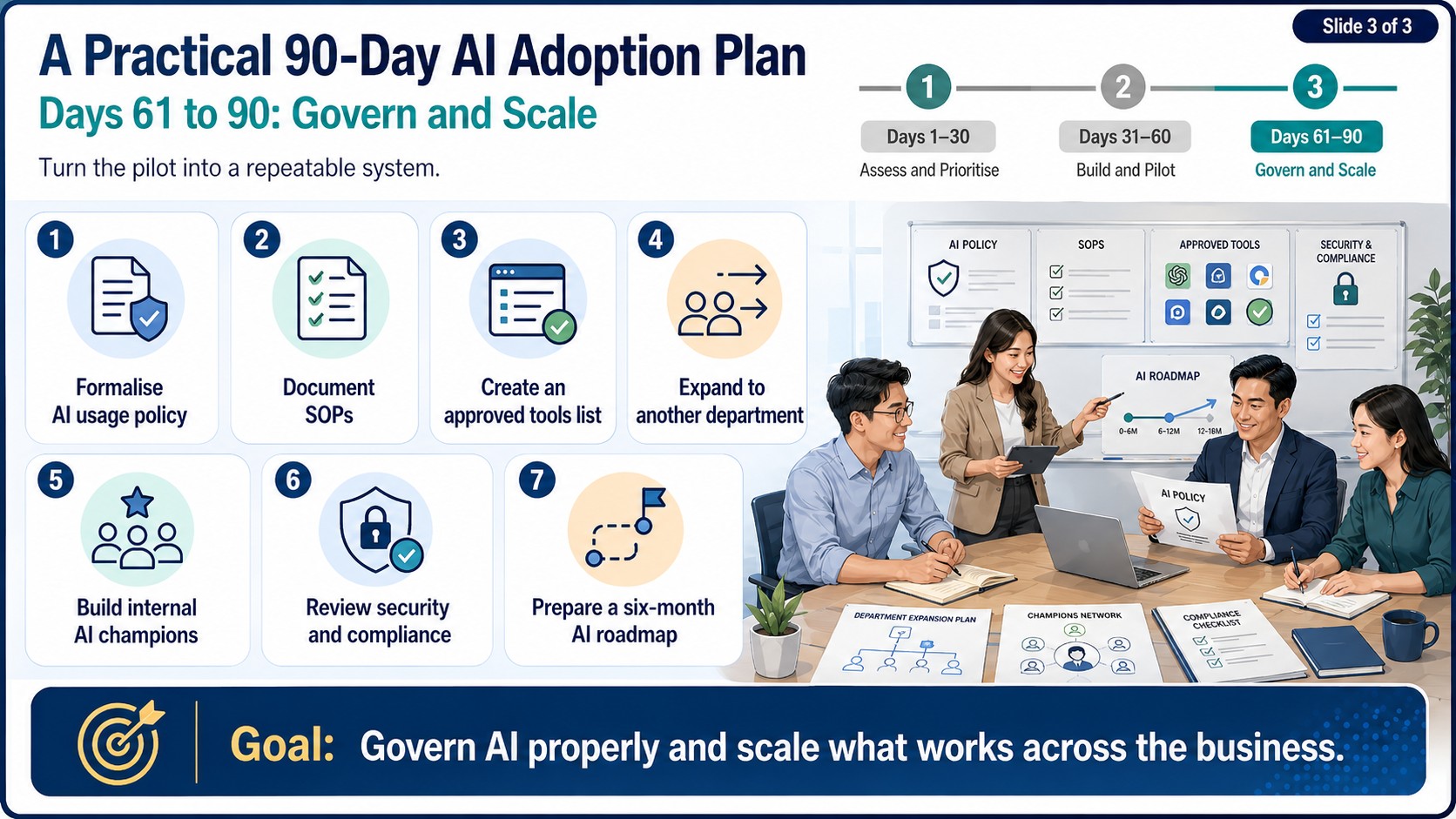
A Practical 9-Days AI adoption Plan
Day 1-30 : Assess and Prioritize (Start with AI Readiness Assessment)
Day 31-60 : Pilot and Train – Launch a Controller AI Pilot
Day 61-90 : Govern and Scale – Turn the Pilot into Repeatable System
How Much Do AI Consulting Services Cost in Singapore?
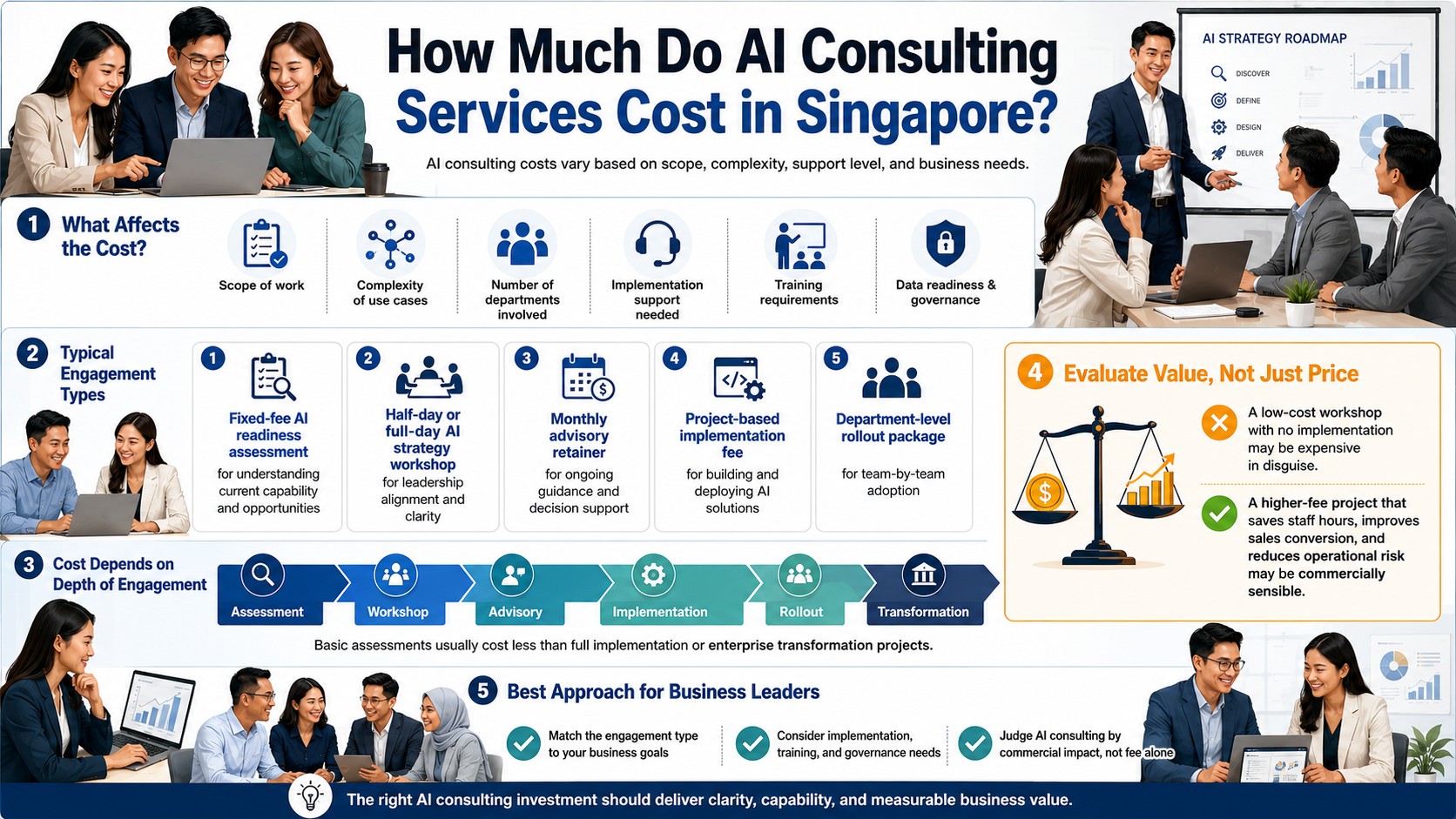
The cost of AI consulting services in Singapore depends on the following
- Scope
- Complexity
- Number of departments involved
- Level of implementation support
- Training requirements
- Fata readiness
- Governance needs
A basic AI readiness assessment may cost significantly less than a full AI transformation project. A workshop-based engagement may be suitable for companies that need clarity. A larger implementation project may include workflow automation, system integration, training, governance, and ongoing optimisation.
Common pricing models include:
- Fixed-fee AI readiness assessment
- Half-day or full-day AI strategy workshop
- Monthly advisory retainer
- Project-based implementation fee
- Department-level rollout package
- Enterprise AI transformation engagement
Business leaders should evaluate AI consulting based on value, not just cost.
A low-cost workshop that produces no implementation may be expensive in disguise. A higher-fee project that saves hundreds of staff hours, improves sales conversion, and reduces operational risk may be commercially sensible.

When Should Your Business Hire an AI Consultant?
You should consider hiring an AI consultant if:
- Your staff are already using AI without policy.
- You want to adopt AI but do not know where to start.
- You have many repetitive manual workflows.
- You want to improve productivity without simply adding headcount.
- Your sales, marketing, HR, finance, service, or operations teams are overloaded.
- You are concerned about data privacy and cybersecurity.
- You tried AI tools but did not see measurable results.
- You want to train your team properly.
- You need an AI roadmap for management approval.
- You want to move from experimentation to implementation.
The best time to engage an AI consultant is before your company has too many disconnected tools, duplicated workflows, and unmanaged risks.
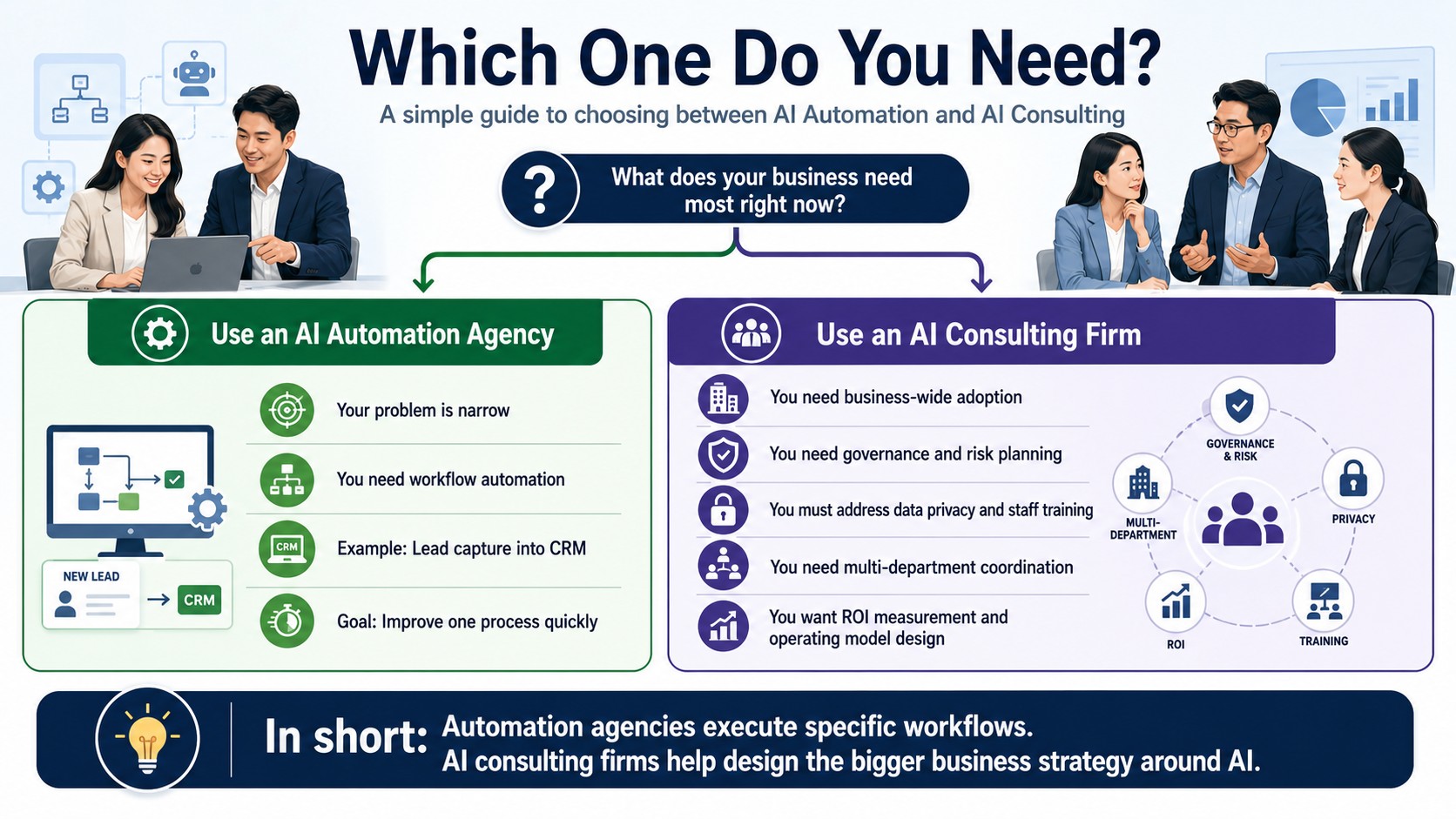
AI Automation Agency Vs AI Consulting
An AI automation agency usually focuses on building automated workflows. An AI consulting firm takes a broader view of business goals, governance, adoption, risk, and operating model design.
If your problem is narrow, such as automating lead capture into a CRM, an automation agency may be enough.
If your problem involves business-wide adoption, data privacy, staff training, governance, multiple departments, and ROI measurement, AI consulting is usually more appropriate.

Frequently Asked Questions About AI Consulting Services in Singapore
What are AI consulting services?
AI consulting services help companies plan, implement, and govern artificial intelligence solutions. This may include AI strategy, readiness assessment, workflow automation, generative AI adoption, AI governance, staff training, tool selection, and ROI measurement.
Why do businesses in Singapore need AI consulting?
Businesses in Singapore need AI consulting because AI adoption is becoming a competitive necessity, but successful implementation requires more than buying tools. Companies need strategy, governance, training, workflow redesign, data readiness, and measurable business outcomes.
What does an AI consultant do?
An AI consultant helps a company identify high-value AI use cases, assess readiness, choose suitable tools, redesign workflows, train staff, manage risks, and measure results. The consultant connects AI technology to business outcomes.
Is AI consulting suitable for SMEs?
Yes. SMEs can benefit from AI consulting by starting with practical use cases such as sales follow-up, customer service support, marketing content, document processing, meeting summaries, HR screening, and internal knowledge management.
What is the difference between AI consulting and AI training?
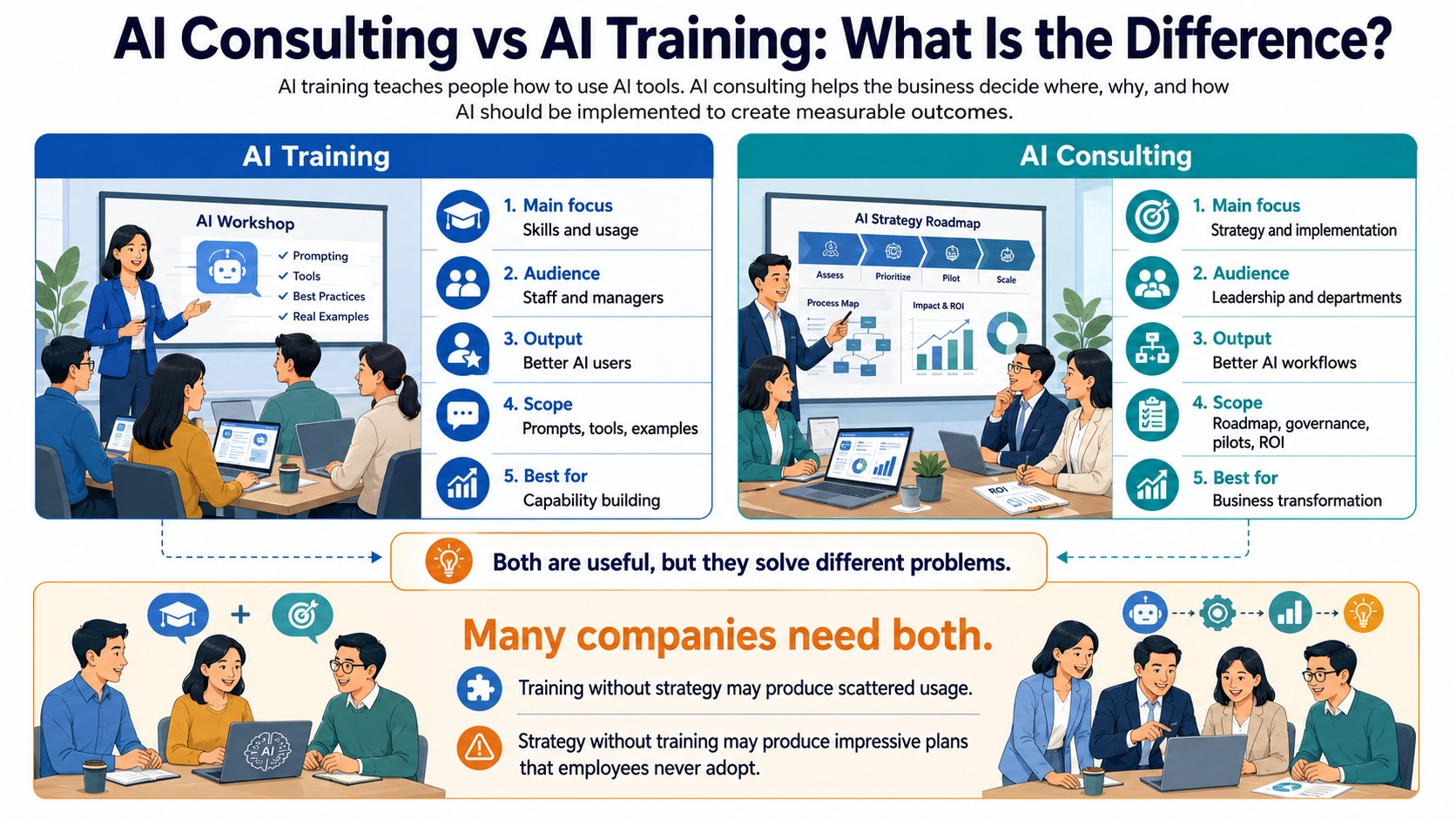
AI training teaches employees how to use AI tools. AI consulting helps the business decide where AI should be applied, how it should be implemented, what risks must be managed, and how results should be measured.
How long does an AI consulting project take?
A basic AI readiness assessment may take a few weeks. A pilot implementation may take 30 to 90 days. A larger enterprise-wide AI transformation programme may take several months, depending on complexity, data readiness, integrations, and change management needs.
What are the best AI use cases for Singapore SMEs?
Useful AI use cases for Singapore SMEs include AI-assisted customer service, sales proposal generation, lead qualification, marketing content workflows, HR screening support, invoice processing, meeting summaries, internal knowledge search, and management report drafting.
How do I choose an AI consultant in Singapore?
Choose an AI consultant who understands business outcomes, workflow redesign, governance, cybersecurity, staff training, and implementation. Avoid consultants who only recommend tools without assessing your business goals, data risks, and operational needs.
Is AI safe for business use?
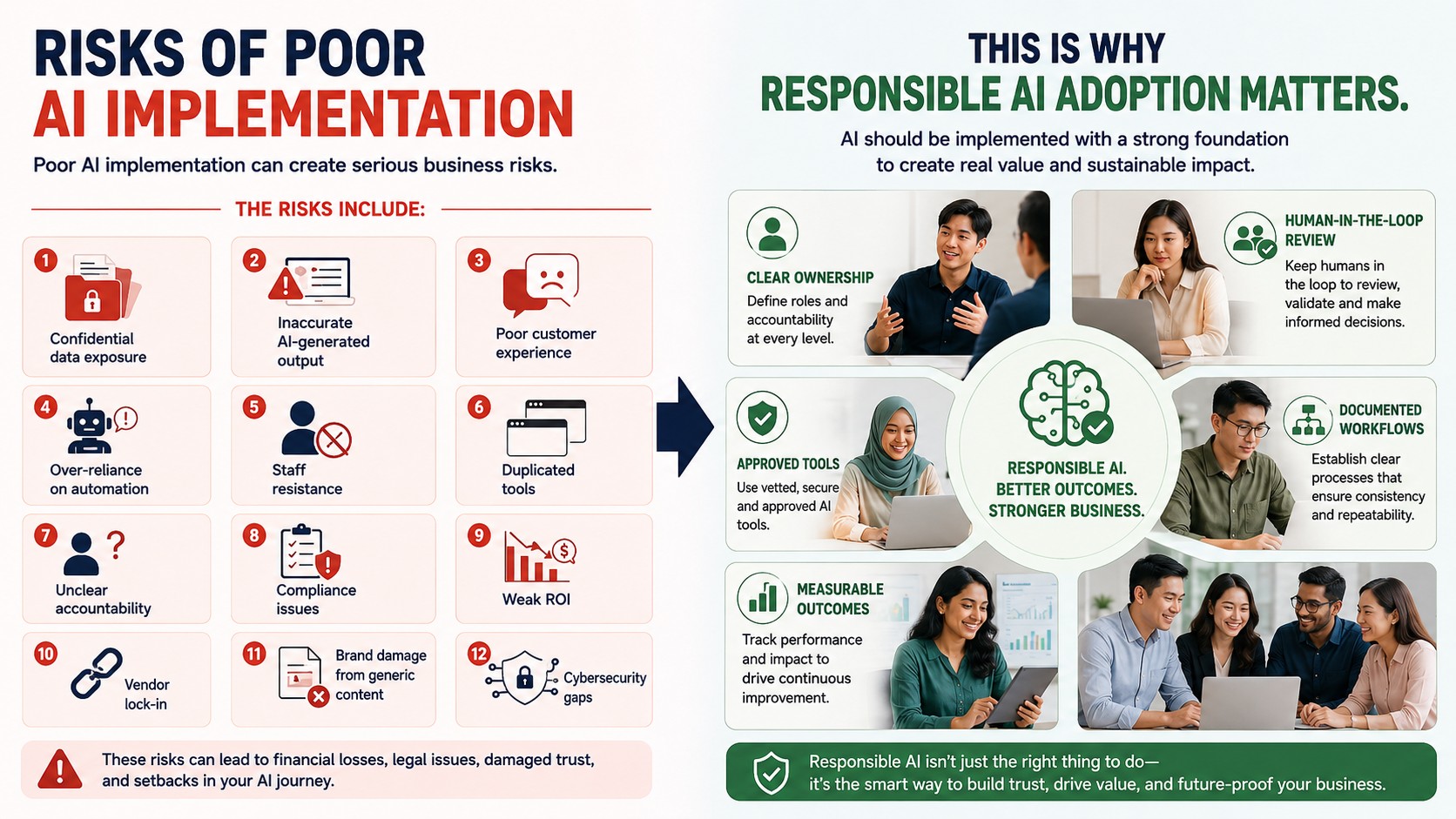
AI can be safe for business use if implemented with proper governance. Companies should define approved tools, data privacy rules, human review steps, vendor controls, cybersecurity measures, and employee usage guidelines.
What is the first step to adopting AI?
The first step is to conduct an AI readiness assessment. This helps your company identify suitable use cases, understand risks, review data readiness, prioritise opportunities, and create a practical roadmap.
Ready to Implement AI Strategically?
AI can help your business work faster, serve customers better, reduce manual effort, improve decision-making, and build a future-ready workforce.
But AI only creates real value when it is implemented properly.
The companies that benefit most from AI are not the ones that collect the most tools. They are the ones that connect AI to strategy, workflows, people, governance, and measurable business outcomes.
If your organisation is exploring AI consulting services in Singapore, start with a structured AI readiness assessment.
We can help you identify the best AI opportunities for your business, prioritise practical use cases, train your team, manage governance risks, and build a clear roadmap for strategic AI implementation.
Book an AI Strategy Consultation today and discover how your business can turn AI ambition into measurable results.