Singapore is home to more than 79 cybersecurity consultancies, each promising to protect your digital assets. This crowded market makes choosing the right penetration testing Singapore provider harder than it looks.
We view this as a strategic business decision, not a compliance checkbox. Singapore’s Cybersecurity Act and CSA licensing requirements make vendor selection a governance issue. A poorly executed vulnerability assessment Singapore engagement can expose your organization to real financial and reputational risk.
This guide explains what matters in a cybersecurity consulting Singapore engagement. We focus on measurable, verifiable criteria instead of vague marketing claims. You’ll learn to assess penetration testing credentials and compliance alignment and compare support from IT maintenance services for year-round defense.
Our aim is straightforward. We want business leaders to make this choice with confidence and clarity.
1. Why Choosing the Right VAPT Company Matters in Singapore
The decision to hire a VAPT company Singapore businesses can trust goes beyond a technical scan. Regulators including the Cyber Security Agency, Monetary Authority of Singapore, and Personal Data Protection Commission expect cybersecurity risk management. A checklist exercise no longer meets these expectations.
A poorly matched testing partner can leave gaps that quietly undermine years of digital investment. Breaches and compliance failures bring real costs, including regulatory fines, customer churn, and lasting damage to stakeholder trust. These outcomes threaten business continuity in Singapore, where companies compete on reliability as much as innovation.
We view this choice as strategic. The right VAPT firm becomes a long-term security partner, not a one-time vendor. This partnership supports digital transformation at scale and protects the value your business has worked hard to build.
The table below shows how a transactional vendor differs from a true strategic partner:
| Factor | Transactional Vendor | Strategic VAPT Partner |
|---|---|---|
| Engagement Scope | One-time scan with a generic checklist | Ongoing VAPT services tailored to your risk profile |
| Regulatory Alignment | Minimal mapping to local rules | Direct alignment with CSA, MAS, and PDPA requirements |
| Business Impact | Short report with little follow-up | Stronger business continuity and lasting risk reduction |
2. Step 1: Define Your VAPT Scope and Business Needs

A clear VAPT scope guides useful security testing and prevents wasted money. Before contacting a VAPT company in Singapore, decide what to protect and why. This planning guides later talks about technical needs and final prices.
Identify Your Critical Assets and Attack Surface
We map each system that handles sensitive data or supports core operations. These systems include internal networks, customer-facing applications, cloud infrastructure, and third-party integrations.
A careful attack surface assessment finds hidden entry points attackers could use. Many Singapore businesses miss legacy systems or API connections that increase their risk.
Listing these assets early helps vendors provide accurate quotes and test what matters most.
Decide Between Black Box, White Box, or Gray Box Testing
Each method answers a different question. Black box testing simulates an outside attacker without system knowledge. This method measures real-world exposure.
White box testing gives testers full access to source code and architecture. It can uncover deeper flaws that external scans may miss.
Gray box testing combines both approaches. It offers a practical balance for businesses with limited time or a tighter budget.
Set Clear Objectives, Timelines, and Budget Expectations
We suggest matching testing goals with priorities such as compliance deadlines, product launches, or investor due diligence. Clear objectives keep every stakeholder focused on the same outcome.
A realistic penetration testing budget depends on scope complexity, asset count, and testing depth. Set these expectations early to avoid costly surprises and poorly matched proposals during vendor selection.
3. Step 2: Verify Credentials and Industry Certifications
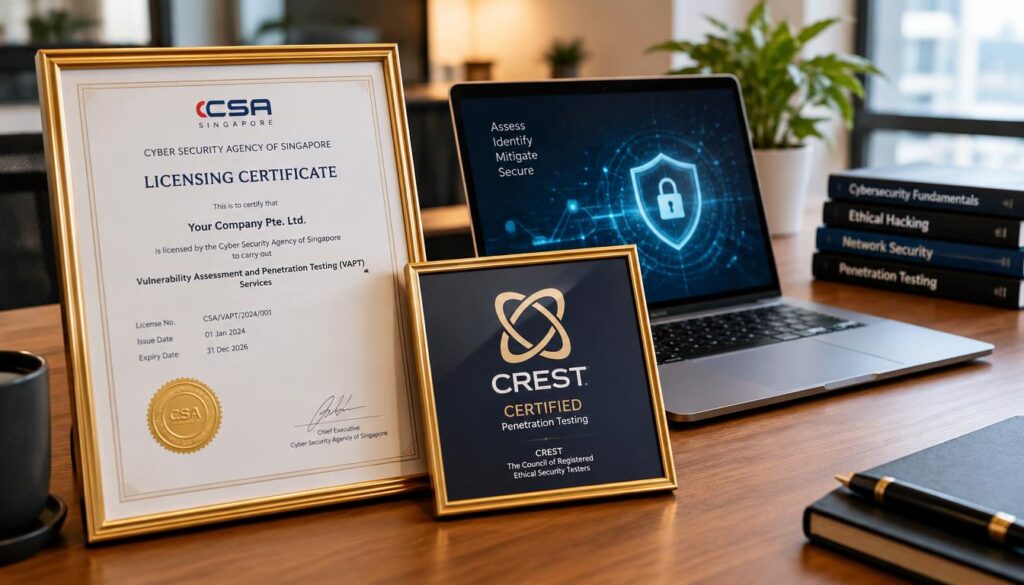
Before signing a contract, smart leaders check the credentials behind a VAPT provider’s claims. Evaluating VAPT provider credentials means looking beyond sales talk for licenses, certifications, and proven delivery. We outline three credential checks every Singapore business should complete before choosing a provider.
Check for CSA Licensing Under Singapore’s Cybersecurity Act
Many business owners assume vulnerability assessments and penetration testing share the same rules. The CSA licensing Singapore businesses need covers penetration testing, not vulnerability scanning. The Cyber Security Agency of Singapore regulates it as a distinct, licensable service.
This difference matters because buyers, not vendors, must verify compliance. We recommend confirming that your provider holds a current CSRO licence before any engagement begins.
This requirement also applies to the primary vendor’s subcontractors. Any subcontractor involved in testing must hold a valid CSRO licence. Skipping this check can create unexpected compliance gaps for your organization.
Look for CREST, OSCP, and Other Recognized Certifications
CSA licensing confirms legal compliance, but it does not show technical depth. Internationally recognized certifications add a second layer of assurance about testing skills.
CREST certification signals that a firm’s methods, quality controls, and tester skills meet strict international benchmarks. OSCP certification, held by individual testers, proves hands-on exploitation skills through a practical exam, not multiple-choice questions.
Other credentials, such as OSCE, GPEN, and CEH, show a tester’s broader technical range. Ask which certifications individual testers hold, rather than relying only on company website logos.
| Credential | Issuing Body | What It Verifies | Relevance to Buyers |
|---|---|---|---|
| CSRO Licence | Cyber Security Agency of Singapore | Legal authorization to conduct penetration testing | Mandatory for compliant engagements in Singapore |
| CREST | CREST International | Firm-level methodology and quality assurance standards | Confirms organizational testing rigor |
| OSCP | Offensive Security | Individual hands-on exploitation skill | Validates tester-level technical competence |
| GPEN | GIAC / SANS Institute | Practical penetration testing methodology knowledge | Supports claims of structured testing approach |
Review Track Record, Case Studies, and Client References
Singapore’s cybersecurity consulting market includes boutique specialists and established regional firms. Softscheck Apac has operated since 2001, with a strong ISO27034 focus. SEC Consult Singapore brings decades of European application security expertise to the local market.
ABP Group places itself among Asia’s leading cybersecurity technology providers, while Hexadius Consulting specializes in IAM, SAP security, and VAPT engagements. This range gives buyers real choices, but due diligence must go beyond company names.
Request documented case studies, sector-specific references, and evidence of similar past engagements. These examples should match your own risk profile.
Ask for evidence supporting claims about CCoP, MAS TRM, and PDPA alignment. This step protects your organization long after the engagement ends.
4. Step 2: Evaluate Testing Methodology and Tools
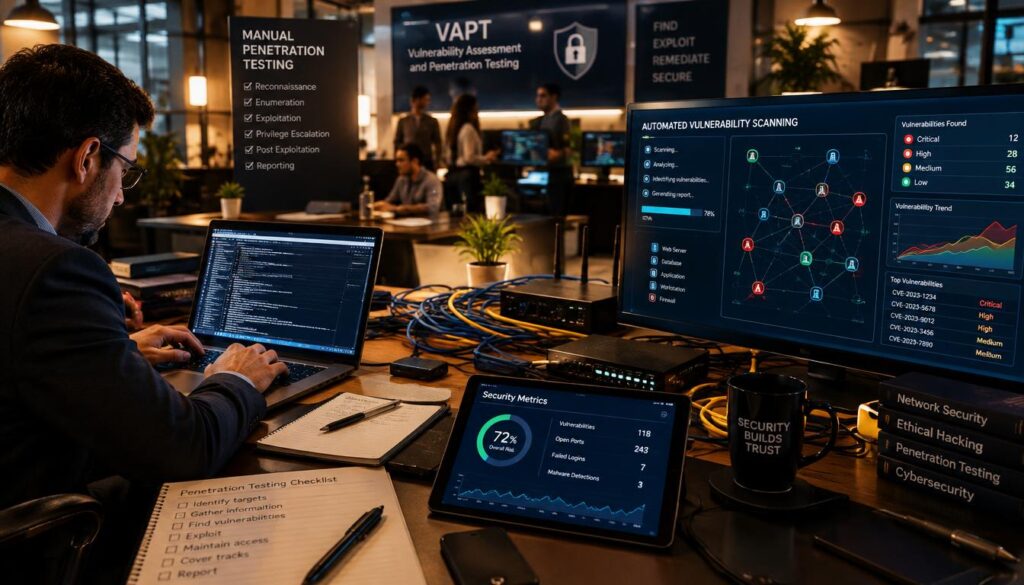
Credentials open the door, but methodology separates a thorough security assessment from a superficial checklist exercise. After checking qualifications, review their VAPT methodology to learn how they test, document, and validate findings. This shows whether a vendor uses surface-level scans or provides the depth your business needs.
Ask About the Balance Between Manual and Automated Testing
Automated vulnerability scanning covers a lot of ground quickly and flags known weaknesses across large systems. However, scanners miss business-logic flaws, chained exploits, and context-specific risks that trained experts can find.
The strongest providers use a human-in-the-loop process. They combine automation for breadth with manual penetration testing for depth, allowing experts to interpret results and find subtle attack paths.
Confirm Alignment With OWASP, NIST, and PTES Standards
Recognized frameworks make security testing consistent and repeatable. Ask providers how their process maps to OWASP standards, NIST guidelines, and the PTES framework.
A provider who explains this alignment clearly shows structured thinking, not guesswork. It also helps you compare results across testing cycles or vendors over time.
Assess How They Handle Zero-Day and Emerging Threats
Known vulnerabilities tell only part of the story. Strong zero-day threat detection shows that a provider invests in threat intelligence, not just CVE database lookups.
Ask how the team identifies novel attack patterns and emerging risks before they become public knowledge. A provider with mature threat intelligence processes, rather than reactive tooling alone, gives your business a genuine edge against evolving cyber risks.
5. Step 3: Assess Compliance and Regulatory Expertise
Technical skill alone cannot ensure a VAPT engagement meets Singapore’s regulatory standards. Regulatory fluency separates basic testing from a defensible compliance program. Before signing, ask vendors about the rules that govern your industry.
Singapore regulators rarely accept a clean final report as proof of due diligence. The CSA Code of Practice, MAS TRM guidelines, and PDPA require records showing that testing occurred as planned. Your organization carries the burden of proof, so your records must match the service delivered.
Understand PDPA Obligations and Secure Data Handling
The Personal Data Protection Act requires reasonable security measures that protect personal data from unauthorized access. An experienced VAPT partner can turn test results into evidence of this duty. Ask how providers support PDPA compliance Singapore beyond scans, including their handling of sensitive data found during testing.
Check Experience With MAS Technology Risk Management Guidelines
Financial institutions face stricter rules under MAS TRM guidelines, including set testing schedules and detailed records. A provider may deliver strong testing that still fails an audit if it does not understand these rules. Ask about work with banks or payment firms, and look for specific MAS examples instead of broad security claims.
Confirm Familiarity With Industry-Specific Regulations
Healthcare and critical infrastructure have their own rules, which generic testing may overlook. Strong regulatory compliance cybersecurity partners tailor testing to industry standards and understand industry-specific VAPT regulations. This detail protects your digital transformation efforts from compliance setbacks that can stop progress.
| Framework | Applicable Sector | Key VAPT Requirement | Documentation Standard |
|---|---|---|---|
| PDPA | All organizations handling personal data | Reasonable security arrangements | Evidence of testing and remediation tracking |
| MAS TRM Guidelines | Banks, insurers, payment firms | Independent testing at defined intervals | Detailed audit trail and risk-based scoping |
| CSA Code of Practice | Critical information infrastructure | Regular penetration testing and assessment | Formal reporting aligned to CSA expectations |
A provider who understands these frameworks helps prevent costly gaps between rules and delivered services. Compliance readiness does not happen automatically after good testing. It requires a partner who values documentation as much as technical work.
6. Step 4: Compare Reporting Quality, Support, and Pricing
Any VAPT engagement shows its value in the report and support you receive afterward. A sound test helps little if nobody can understand or act on its findings. Before signing, Singapore businesses should review communication, remediation help, and fees.
Request Sample Reports for Clarity and Actionability
Always ask for a redacted sample report before choosing a vendor. Strong VAPT report quality means clear risk levels, plain language, and solid evidence.
Good reports serve technical teams and business leaders. Technical teams need steps to reproduce issues and detailed fixes. Executives need a summary linking vulnerabilities to business risk without jargon.
Evaluate Post-Assessment Support and Remediation Guidance
A credible provider stays available after sending your report. Real remediation support gives you tester access, ranked fixes, and retesting after repairs.
Ask how the provider handles vulnerability remediation guidance. Some providers include free retests during a set period. Others charge for validation, so ask early to plan your budget and avoid surprises.
Compare Pricing Models Without Compromising Quality
Comparing quotes is useful, but the lowest bid rarely tells the whole story. Clear penetration testing pricing should reflect scope, testing depth, and tester experience.
Low-priced work may mean fewer manual testing hours or unlicensed subcontracted testers. Buyers carry the burden of proof for compliance. A cheap test that misses critical flaws can cost more than its savings.
| Pricing Model | Typical Structure | Best Suited For |
|---|---|---|
| Fixed-Scope Project | Flat fee for defined assets and timeframe | Businesses with clear, stable testing boundaries |
| Time-and-Materials | Billed by hours or days of testing effort | Complex environments needing flexible scope |
| Annual Retainer | Ongoing testing and remediation support bundled yearly | Enterprises requiring continuous assurance |
Compare at least three providers side by side. Weigh report samples, support terms, and pricing structure together. This approach protects your budget and compliance standing.
7. Making a Confident, Final Choice for Your Business
This complete framework helps you compare choosing VAPT provider Singapore options by scope, credentials, testing methods, regulations, and reporting. Together, these steps show what a capable security partner should provide.
Choosing a vendor is not a one-time purchase. It begins a cybersecurity partnership Singapore businesses need as threats change. Use this guide as a checklist during vendor discussions. Ask direct questions, request proof of licensing, and review sample reports before signing.
Choose transparency and clear communication over the lowest quote. A provider should explain its process, support findings with evidence, and guide your team through remediation. This support delivers more value than a provider competing only on price.
The right VAPT partner strengthens your security posture over time. It supports regulatory confidence, protects customer trust, and gives your business a stable foundation for growth in Singapore’s digital economy. Choose carefully, as you would with any strategic business decision. Your organization will be better prepared for what comes next.